
Access control system installation for businesses in Bucks County
Emergency service
Qualified Technicians
Guaranteed and Quality
An employee left six months ago. You are not completely sure how many copies of the key exist or who has them. You have thought about rekeying, but this is the third time in two years and you are tired of starting over.
Or maybe your business is growing. You have a back office, a server room, and a storage area that not everyone should be walking into freely. A single master key is not going to cut it anymore.
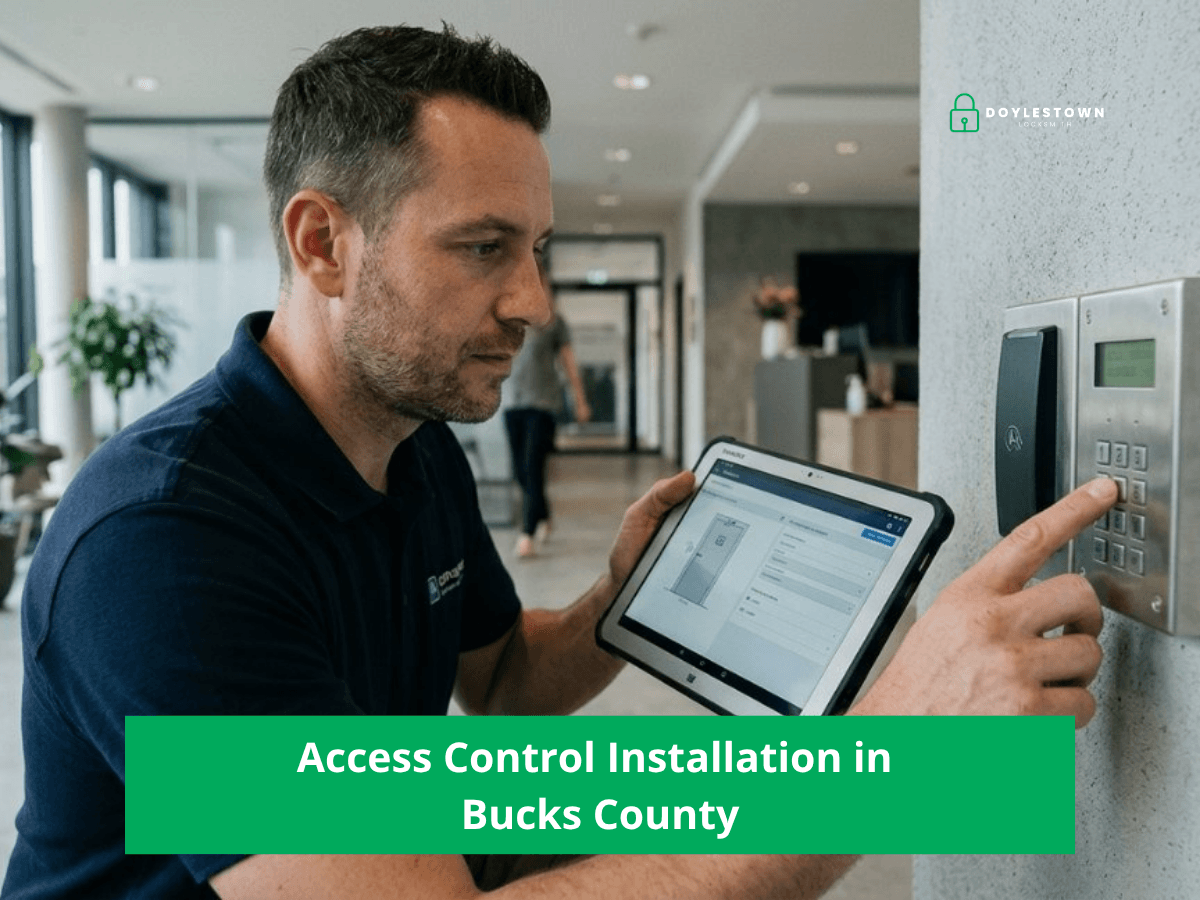
Access control solves both problems. Doylestown Locksmith installs keypad, card reader, fob, and mobile access systems for small and mid-sized businesses across Bucks County. We work with trusted brands like Schlage, HID, and Kisi, and we handle the full installation from property assessment to user setup.
Call 267-440-6484 or request a free quote and we will get back to you the same day.
The problem with traditional keys
A traditional lock has one fundamental weakness: every copy of the key gives identical access, and you have no way of knowing who used it or when.
When you hand a key to an employee, you are making a decision you cannot easily undo. Keys get copied. Keys get lost. Keys leave the building in someone’s pocket when they quit, and you have no way of knowing whether that person made a duplicate before they left.
Rekeying solves the problem temporarily. But every time you rekey, you start the cycle over. If you are rekeying more than once a year, you are spending time and money on a fix that does not actually address the underlying issue.
Access control replaces the key with a credential that you fully control. You issue it, you modify it, and you revoke it the moment you no longer want someone to have access. No rekeying. No physical key to track down. No guessing about who still has a copy.
For businesses weighing access control against rekeying, we cover that comparison directly in the FAQ section below. And if rekeying is genuinely the right solution for your situation, we offer that too through our lock rekeying service.
Types of access control systems we install
There is no single system that is right for every business. Here is how the main options break down, and where each one makes the most sense:
Keypad entry systems
The most straightforward upgrade from a traditional lock. Employees enter a PIN code instead of using a key. No credentials to issue, no cards to lose, no fobs to replace. The tradeoff is that codes can be shared, and if someone memorizes the code before they leave, you need to change it.
Keypad systems from Schlage and HID work well for small offices, storage rooms, and secondary entrances where the priority is convenience over strict accountability. They are also the most affordable entry point into access control.
Card and key fob systems
Each employee carries a card or fob that is programmed to their specific credential. When they present it to the reader, access is granted or denied based on their permission level. You can set different permissions for different employees, restrict access to certain times of day, and pull a log showing exactly who entered a door and when.
HID card systems are the industry standard for this type of setup and are widely used in offices, medical facilities, and multi-tenant commercial buildings. Cards and fobs are inexpensive to replace, and revoking access is done in the software, not with a locksmith visit.
Mobile access systems
Employees use a smartphone app as their credential instead of a card or fob. Systems like Kisi allow you to manage access from anywhere: grant a new employee access before their first day, revoke it from your phone the moment someone is let go, and review the access log from your laptop without being on-site.
Mobile access is particularly useful for businesses with remote management needs, multiple locations, or frequent staff turnover. It eliminates the cost of issuing and replacing physical credentials and gives you real-time visibility into who is in the building.
Biometric systems
Fingerprint or facial recognition readers are available and appropriate for high-security areas where credential sharing is a serious concern. We install biometric devices for server rooms, pharmaceutical storage, and other restricted areas where the cost of unauthorized access is high enough to justify the investment. For most small business applications, card or mobile access provides sufficient security at a lower cost.
Why businesses in Bucks County are making the switch
Access control upgrades are rarely planned far in advance. Most of the calls we get start with a specific event:
An employee left and you are not sure about the keys
This is the most common trigger. A staff member left under good terms or bad, and now you are doing the math on how many key copies are out there. Rekeying is the quick fix. Access control is the permanent solution. If this has happened more than twice in the past few years, the math almost always favors the upgrade.
You failed a security audit or your insurance company asked questions
Some insurance carriers, especially for businesses handling sensitive data or pharmaceuticals, require documented access control as a condition of coverage. Others offer premium discounts for businesses that can demonstrate who has access to what. If you got a letter or a question you did not have a good answer for, that is a reasonable prompt to move forward.
You have areas that not everyone should access
A back office with financial records. A server room. A storage area with high-value inventory. A medication cabinet in a clinic. Traditional locks with a single key do not let you grant selective access. Access control lets you give each employee exactly the access they need and nothing more. You can also restrict access by time, so the cleaning crew has access during evening hours but not on weekends.
You are growing and need a system that scales
Adding a new location or a second floor does not require starting over with access control. Most modern systems let you add doors, add users, and expand permissions without replacing the core infrastructure. If you are planning growth, it is worth installing a platform now that can handle where you are going, not just where you are.
For businesses that also need emergency exit compliance on those same doors, access control can be paired with panic bar hardware. We cover that integration in our panic bar installation page.
How the installation works
- Property assessment: We walk the space with you. We look at the doors you need to control, the existing hardware, the door frame material, and how power will be run to each reader. We also ask about your workflow: how many employees, how shifts are structured, whether you need time-based restrictions or just basic credential control.
- System design: We recommend the right platform and hardware for your specific situation. We are not tied to a single product line, so the recommendation is based on what actually fits your needs and budget, not on what we happen to have in stock.
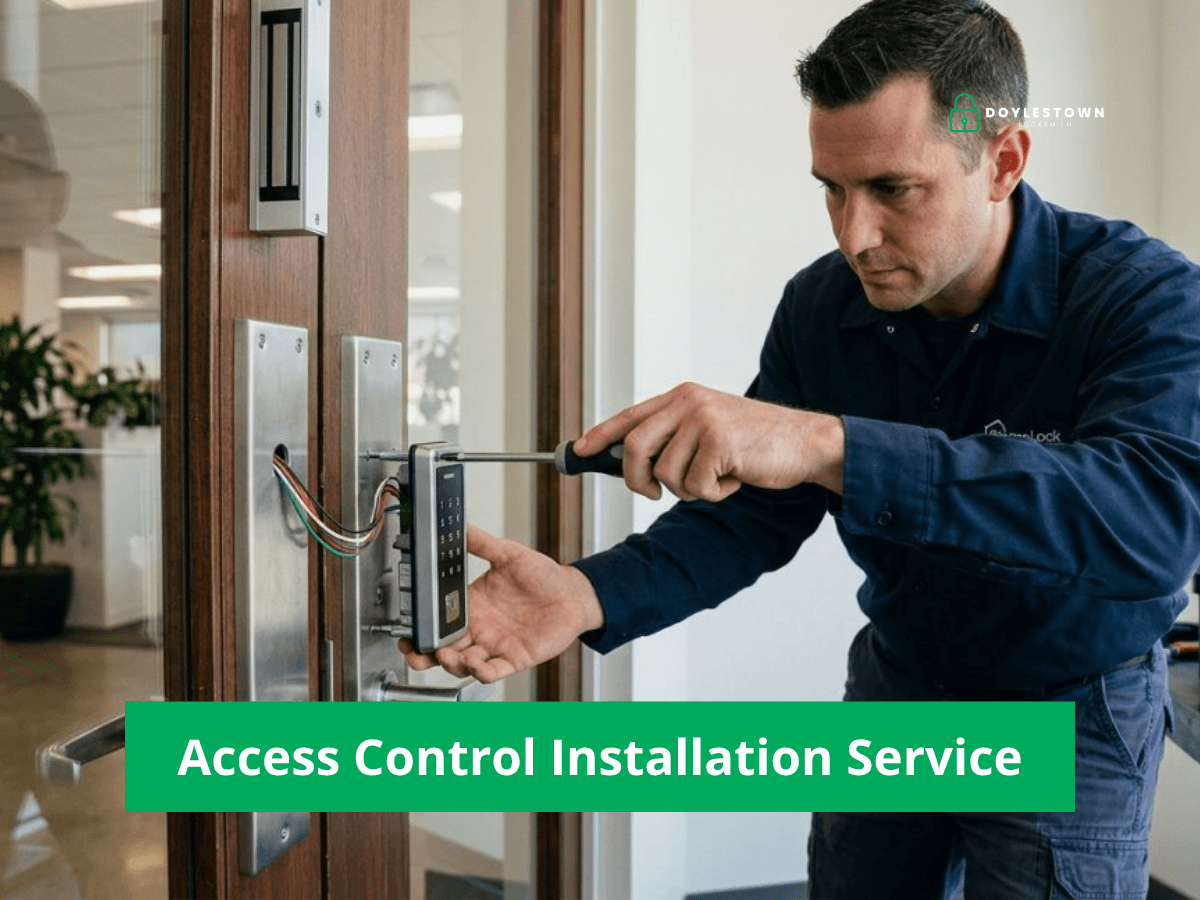
- Installation: We install the reader hardware, run the wiring, connect the door strike or magnetic lock, and integrate the controller. For multi-door installations, we sequence the work so your business operations are disrupted as little as possible.
- User setup: We configure the system, load your initial users, set permission levels, and test every credential before we leave. If the system includes a mobile app, we walk you through the setup on your device.
- Walkthrough and handoff: We show you how to add users, revoke access, pull logs, and handle the most common day-to-day tasks. You should be able to manage the system yourself after installation without calling us for routine operations. We leave our number for anything that is not routine.
Most single-door installations are completed in a single visit. Multi-door commercial projects are scoped in advance with a clear timeline so you can plan around the work.
What you gain with an access control system
A full access log
Every credential presentation is recorded with a timestamp. You can see who entered, which door, and when. If something goes missing or an incident occurs, you have a record to review.
Instant access revocation
An employee is let go this afternoon. You revoke their credential from your phone before they reach the parking lot. No locksmith visit, no rekeying, no wondering whether they made a copy.
Time-based access rules
Delivery staff have access during business hours only. The cleaning crew gets in after 6 PM. Management has unrestricted access. Each role gets exactly what it needs.
A system that grows with you
Adding a new door or a new location is a configuration change, not a new installation from scratch. The platform you start with today handles where you are going tomorrow.
If you manage a building with multiple tenants, a master key system can complement access control for shared areas and maintenance access, without giving building staff the ability to enter individual tenant spaces freely.
Common questions about access control installation
Can it work on multiple doors?
Yes. Most systems are designed to manage multiple doors from a single platform. You can set different permissions per door, so an employee might have access to the front office but not the server room or the warehouse. Multi-door systems are priced per door, so you can start with one entry point and expand when it makes sense.
Can I control access from my phone?
With a mobile-based system like Kisi, yes. You can add users, revoke credentials, check the access log, and in some configurations even unlock a door remotely, all from a browser or app. If remote management is important to you, that factors into which system we recommend during the assessment.
Is access control better than rekeying?
It depends on your situation. If you have stable staffing, low turnover, and one or two doors to manage, rekeying is a reasonable and cost-effective solution. Our lock rekeying service handles that if it is the right fit.
If you rekey more than once a year, have more than five or six employees with physical key access, or need to know who is entering specific areas, access control pays for itself quickly. The break-even point is usually within twelve to eighteen months for a small business with moderate turnover.
How secure is an access control system compared to a traditional lock?
Significantly more secure in most respects. The credentials used in HID card systems use encrypted communication that is not easily cloned. Mobile credentials on platforms like Kisi use multi-factor authentication at the app level. The bigger security advantage, though, is administrative: you know exactly who has access, you can revoke it immediately, and you have a log. Traditional locks offer none of that.
For doors that also need high-security physical hardware, access control readers can be installed alongside heavy-duty lock bodies. We can advise on the right combination during the assessment.
What happens if the power goes out?
Most access control systems have one of two failure modes that you choose during design: fail-safe, meaning the door unlocks when power is lost, or fail-secure, meaning the door stays locked. For emergency exits, fail-safe is typically required by code. For high-security areas, fail-secure is often preferred. Battery backup is also an option for critical doors. We configure this based on your requirements and any applicable code requirements for the space.
Can you install access control on an existing door?
In most cases, yes. We assess the door and frame during the initial walkthrough to confirm compatibility. Electric strikes and magnetic locks can be installed on most commercial door frames. If a door is not well-suited for access control hardware, we will tell you before quoting the job.
Ready to stop managing keys and start managing access?
Call 267-440-6484 or request a free quote online. We serve Doylestown, Warminster, Warrington, Chalfont, New Britain, Furlong, Jamison, Richboro, Montgomeryville and all of Bucks County.