
Door closer installation in Bucks County, PA
Commercial and storefront installations
Repair and replacement
ADA adjustment
Licensed and insured
The door on your restaurant or retail store has been slamming shut for weeks. Every time a customer walks in, there is a bang. Or the closer on your office entrance is leaking hydraulic fluid onto the floor near the entry. Or the fire door in your building no longer closes on its own and your staff has started propping it open.
These are not minor nuisances. A door that slams damages the frame over time, creates a poor first impression, and in the case of a fire door, creates a genuine code compliance problem. A closer that fails to latch means the door is not actually secured when it looks closed.
Doylestown Locksmith installs, adjusts, and replaces door closers for commercial properties throughout Bucks County. We work with professional-grade hardware from brands including LCN, Norton, and dormakaba, and we handle everything from a single storefront closer to multi-door installations across a commercial building.
Call 267-440-6484 or request a free quote to schedule a visit.
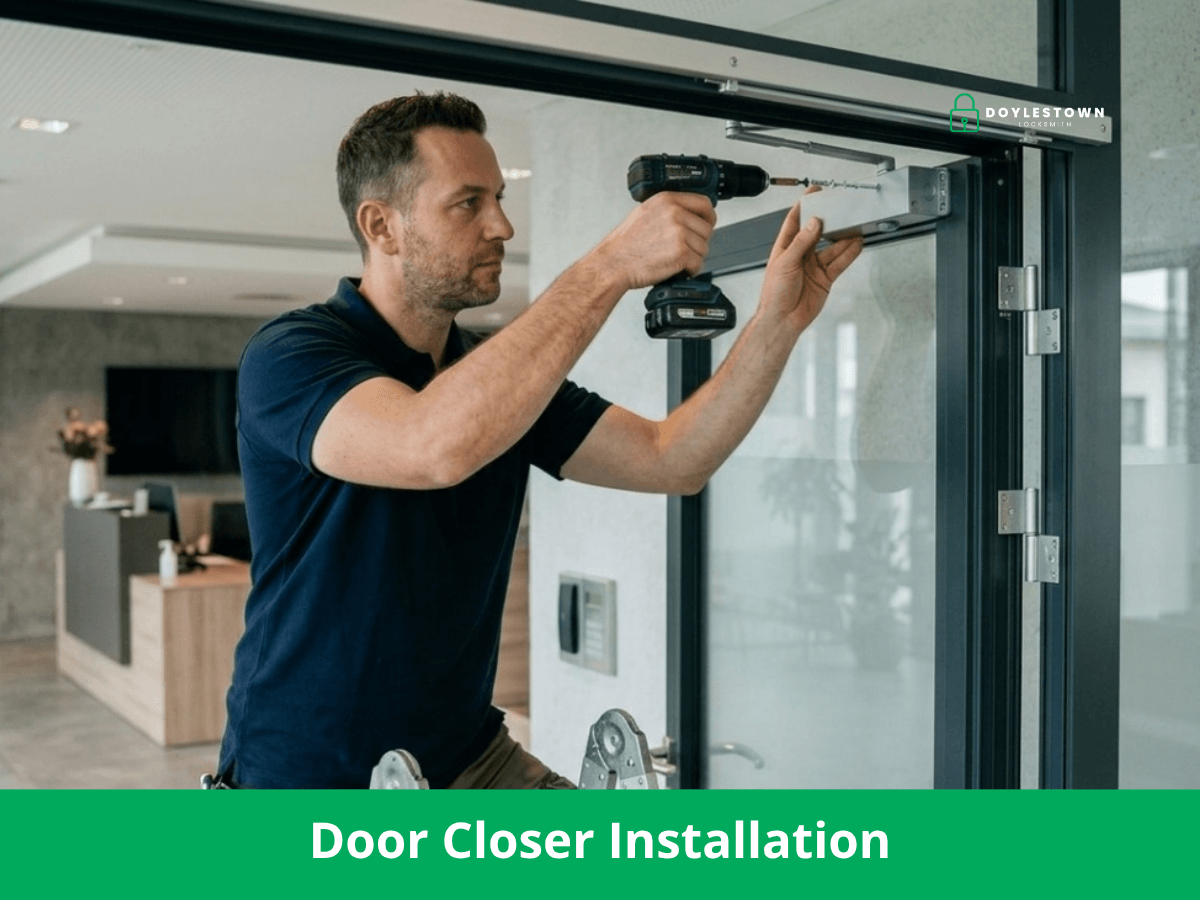
Types of door closers we install
The right closer depends on the door, the traffic volume, the building type, and whether the appearance of the hardware matters. Here is how the main options break down by use case, not by technical category:
Surface-mounted closers for storefronts and offices
The most common installation for commercial doors in Bucks County. The closer is mounted visibly on the door or frame and uses a hydraulic arm to control the speed and force of closing. LCN and Norton surface-mounted closers are the industry standard for this application and are built to handle years of daily use without adjustment.
We install surface-mounted closers in three arm configurations depending on the door and frame geometry: regular arm, parallel arm, and top jamb. The configuration affects both appearance and how the closing force is distributed. We assess the door on arrival and install the configuration that works correctly for your specific opening, not the one that is easiest to mount.
Concealed closers for glass storefronts and modern offices
If the appearance of the door matters, whether because it is a glass storefront, a reception entrance, or a high-end commercial space, a concealed closer is mounted inside the door or frame so no hardware is visible from either side. The closing performance is equivalent to a surface-mounted unit, but the installation is more involved because it requires routing into the door body.
Concealed closers are also the right choice when a surface-mounted unit would be in a position where it could be grabbed, bumped, or vandalized in a high-traffic environment.
Heavy-duty closers for high-traffic and fire-rated doors
A closer rated for a standard office entrance will wear out quickly on a restaurant back-of-house door that swings open and closed several hundred times a day. Heavy-duty closers from LCN’s 4000 series or equivalent dormakaba units are rated for that volume and built with internal components that hold up under constant use.
Fire-rated doors have an additional requirement: the closer must close and latch the door completely from any open position without assistance. A closer that works fine under normal conditions but fails to pull the door fully shut from a 90-degree open position does not meet that requirement. We verify this during testing before we leave.
For buildings where the closer is part of a broader exit hardware setup, we can coordinate the door closer installation with panic bar installation so the door hardware functions as a complete system.
Repair, adjustment, or replacement: what actually determines it
Not every closer problem requires replacing the unit. The honest answer depends on what is actually wrong.
When adjustment solves it
A door that slams, closes too slowly, or does not latch consistently is often a hydraulic adjustment issue, not a hardware failure. Door closers have adjustment valves that control sweep speed, latch speed, and backcheck. A unit that has never been adjusted after installation, or that has drifted over time, will exhibit all of those symptoms even if the internal mechanism is fine. Adjustment takes fifteen to twenty minutes and costs a fraction of replacement.
When repair is not enough
Hydraulic fluid leaking from the closer body means the internal seals have failed. That is not adjustable. A closer with a bent or cracked arm, a stripped mounting plate, or a body that has been physically damaged by a door swinging beyond its stop also cannot be adjusted back to function. In those cases replacement is the right answer, and we will tell you that directly rather than bill for an adjustment that will not hold.
When we replace a closer, we size the new unit correctly for the door weight and traffic volume. An undersized closer will fail faster than the one it replaced. An oversized closer creates an opening force that may not meet ADA standards for accessibility. Sizing is not a guess, it is based on the door width, weight, and the manufacturer’s specification chart.
See our commercial locksmith service for the full range of commercial door hardware we install.
How we handle door closer installation
- On-site evaluation. We inspect the door, frame, hinge condition, and existing hardware. We identify whether the door has a fire rating, whether ADA compliance is a requirement, and whether the frame can support the mounting configuration we recommend.
- Closer selection. We recommend the correct unit based on door width and weight, traffic volume, arm configuration, and any code or accessibility requirements. If you have a preference for a specific brand or series, we work with that. If you want our recommendation, we give it with a reason.
- Installation. We mount the closer body, install the arm, and align the hardware so the door moves through its full range of motion without binding. For concealed installations, we route the door body and frame carefully to avoid weakening the door structure.
- Hydraulic adjustment. We set the sweep speed so the door closes at a controlled pace without slamming, the latch speed so the final inch of travel is fast enough to engage the latch cleanly, and the backcheck if the door needs protection against being forced open too far. For doors requiring delayed action, we set the hold-open timing.
- Full function test. We open the door to multiple positions and verify it closes and latches correctly from each one. For fire-rated doors, we verify the closer pulls the door fully shut from a wide-open position. We do not close out the job until the door operates correctly through the full cycle multiple times.
Most single-door closer installations are completed in 45 to 90 minutes. Multi-door commercial projects are scoped in advance with a clear timeline. We give you the estimate before we start, not after.
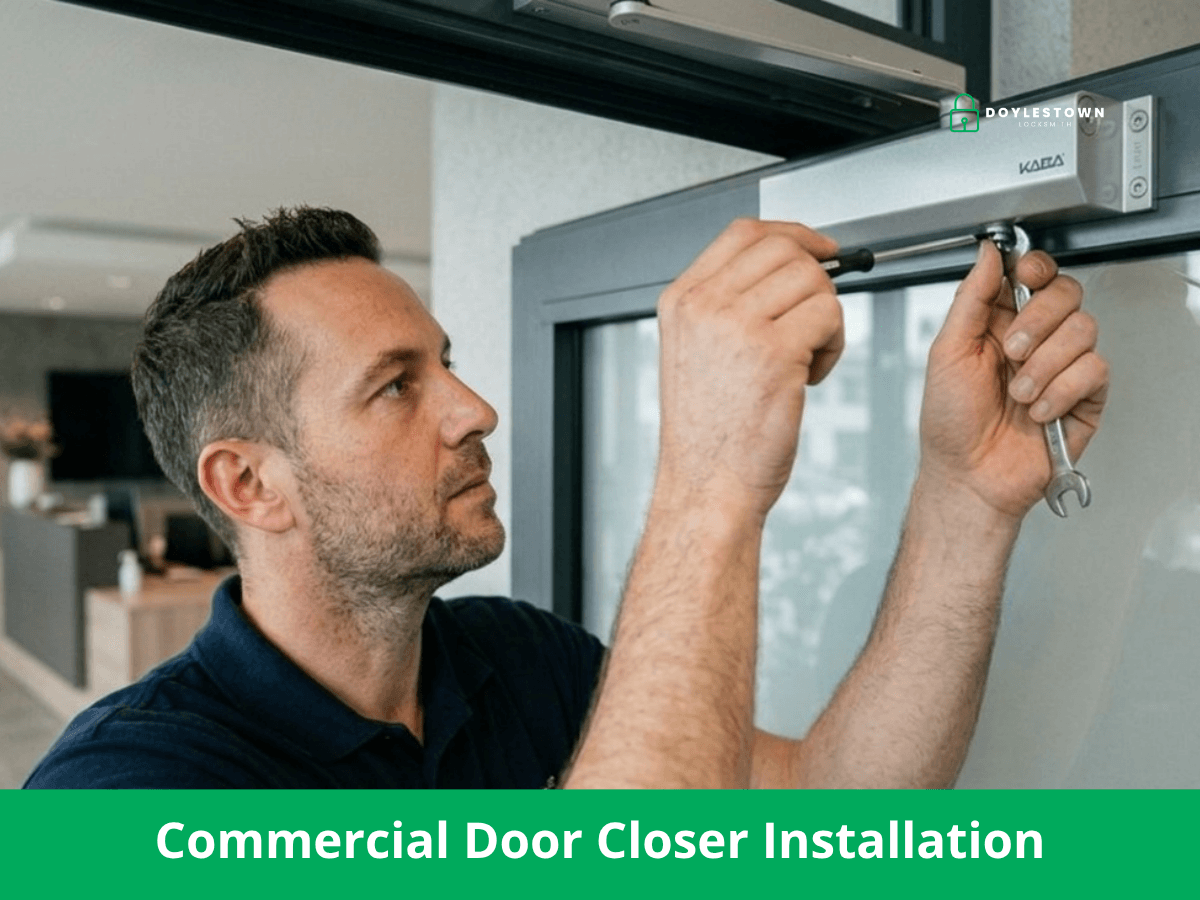
Common questions about door closer installation
My door is slamming. Does the closer need to be replaced?
Usually not. Slamming is almost always a sweep speed adjustment. The closer has a valve that controls how fast the door moves through the first portion of its travel. If that valve has drifted or was never set correctly, the door slams. We adjust it in a single visit. If the adjustment does not hold because the internal mechanism is worn, that tells us replacement is needed, but we do not start there.
The closer is leaking fluid. Can it be repaired?
No. Hydraulic fluid leakage means the internal seals have failed and the unit needs to be replaced. There is no service that restores a leaking closer to reliable function. We replace it with a correctly sized unit and dispose of the old one.
Can you install a closer on a glass storefront door?
Yes. Aluminum-framed glass storefront doors are a standard installation for us. The frame material and door weight factor into which closer and arm configuration we use, but glass storefront doors are a routine application.
Do you handle ADA compliance adjustments?
Yes. ADA standards specify maximum opening force for interior and exterior doors and minimum closing time from 90 degrees to within three inches of the latch. If your closer makes the door too difficult to open or closes too fast for accessibility, we adjust it to bring it within those parameters. We also document the adjustment if you need a record for a compliance review.
Can you coordinate closer installation with other door hardware?
Yes. If the door also needs a panic bar, an electric strike for access control, or a lock change, we can handle the full hardware package in a single visit. Coordinating the hardware from the start avoids compatibility issues and saves you the cost of multiple service calls.
Do you service properties outside Doylestown?
We cover all of Bucks County including Warminster, Warrington, Chalfont, New Britain, Furlong, Jamison, Richboro, Montgomeryville, Southampton, and surrounding areas. For commercial properties with multiple locations in the county, we can schedule visits to cover all sites.
Door slamming? Closer leaking?
Needs replacement? Call 267-440-6484 or request a free quote online. We serve commercial properties throughout Bucks County.