
Car ignition repair and replacement – mobile service in Bucks County
Emergency service
Qualified Technicians
Guaranteed and Quality
The key goes in. Nothing happens. Or it turns partway and stops. Or worse, it goes in and you cannot get it back out.
Ignition problems have a way of happening at the worst possible moment: in a parking lot, before an early meeting, at the end of a long day. And the standard advice, tow it to the dealer, wait several days, pay several hundred dollars, is not the only option.
Doylestown Locksmith handles ignition repair and replacement as a mobile service across Bucks County. We come to wherever your car is, diagnose the problem on the spot, and in most cases resolve it in a single visit. No tow truck. No waiting days for a service appointment.
Call 267-440-6484 for immediate help, or request a quote if you have time to plan ahead.
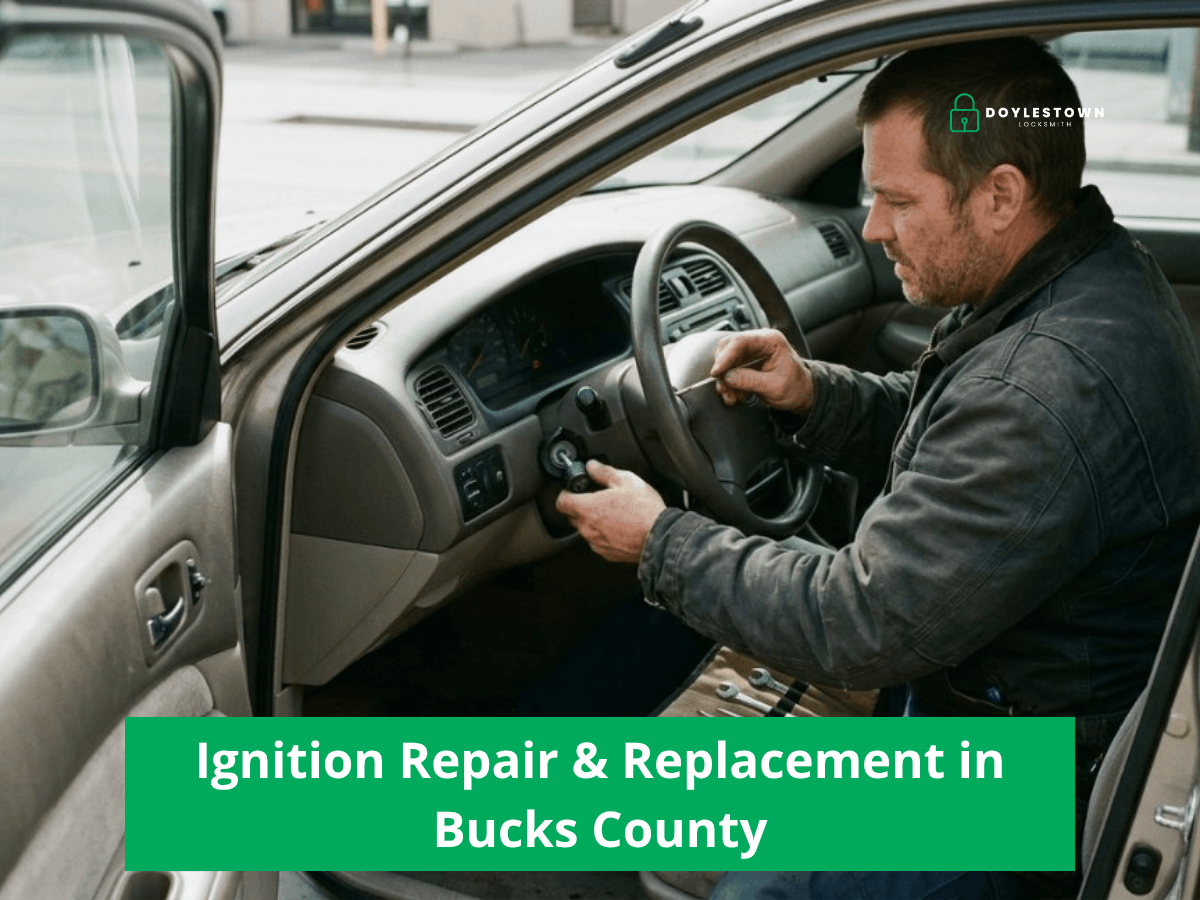
Signs your ignition needs attention
Ignition cylinders wear down gradually. Most people notice the early signs for weeks or months before the problem becomes a full failure. Here is what to watch for and what each symptom usually means:
Before you call a locksmith: rule out the steering wheel lock
If your key suddenly will not turn and this has never happened before, try this first: with the key inserted, apply gentle pressure in the direction you would normally turn to start the car, and at the same time move the steering wheel slightly from side to side. Many cars have a steering wheel lock that engages when the wheel is turned after the car is switched off. It is not an ignition problem, and it does not require a locksmith. If the key turns once you try this, you are fine.
If it does not, read on.
The key turns hard or requires multiple attempts
This is the earliest and most commonly ignored symptom. The key goes in, but starting the car requires more effort than it used to. Sometimes you have to wiggle it slightly. Sometimes the first attempt fails and the second works. This is the ignition cylinder telling you the internal pins are worn and are no longer aligning cleanly with your key. It will get worse. The question is whether it gets worse in your driveway or in a parking lot fifteen miles from home.
The key will not turn at all
A complete failure to turn. The steering wheel lock has been ruled out. The key goes in smoothly but refuses to rotate. In most cases this means the cylinder pins are too worn to align even with the correct key, or the cylinder itself has seized. In some cases a worn key is contributing to the problem, which is why diagnosis matters before recommending repair vs. replacement.
The key is stuck and will not come out
The car may or may not have started. Either way, the key is in and it is not coming out. This can happen because of a worn detent mechanism inside the cylinder, or because the shift interlock on automatic transmission vehicles is not fully registering park. If the key broke off inside the cylinder, that is a separate but related problem we also handle. See our broken key extraction service for that specific situation.
The ignition turns but the car does not start
The cylinder rotates normally, but the engine does not turn over. This separates into two possible causes: a mechanical problem with the ignition switch behind the cylinder, or an electronic issue with the transponder communication between the key and the car’s immobilizer system. A locksmith can diagnose and resolve both, but they are different problems with different solutions.
The ignition spins freely without resistance
The key turns but there is almost no resistance, like turning a key in a lock with no mechanism behind it. The cylinder has failed internally. This usually happens after a break-in attempt where someone tried to force the ignition, or after a long period of wear where the internal components have degraded past the point of function.
Repair or replacement: what actually determines it
Not every ignition problem requires full replacement, and not every problem can be resolved with a simple repair. Here is how we think through it:
When the cylinder can be repaired
If the internal pins are worn but the cylinder housing and the electrical switch behind it are intact, the cylinder can often be rebuilt or rekeyed rather than replaced. This is less expensive and, in most cases, faster. If the issue is a worn key contributing to cylinder wear, a new key combined with a cylinder service can restore normal function. We carry common cylinder components and can often resolve this in a single visit.
When full replacement is necessary
If the cylinder housing is damaged, if a break-in attempt deformed the internal components, or if the electrical ignition switch behind the cylinder has failed, replacement is the right path. We remove the old assembly, install a new cylinder matched to your existing keys where possible, and verify the switch is functioning correctly before we leave.
The transponder complication in modern vehicles
This is the part that catches people off guard. In any vehicle built after the mid-1990s with a transponder key, the ignition cylinder and the key are not independent components. The key contains a chip that communicates with the car’s immobilizer module. If you replace the ignition cylinder with a new one, the existing key may not start the car until it is reprogrammed to match the new cylinder.
A general mechanic can replace the cylinder. What they often cannot do is handle the programming side. We can do both in the same visit. For more on how key programming works across different vehicle types, our car key replacement page covers the full picture.
Why the dealership is rarely the best option for ignition work
When your ignition fails, calling the dealer feels like the safe choice. It is not always the smart one.
Here is what typically happens when you go the dealership route for ignition repair:
- You pay for towing before any work begins: If the car cannot be started, it has to be moved somehow. A tow to the dealer adds cost before anyone has looked at the problem.
- You wait for a service appointment: Most dealers are not booking ignition repairs as same-day emergency work. You are looking at one to several days before the car is even looked at, longer if parts need to be ordered.
- The bill separates into multiple line items: Dealers charge separately for diagnosis, parts, labor, and in vehicles with transponders, programming. Each line has its own markup.
- The car has to come to them: Everything about the dealer model assumes the car can be moved. If it cannot, you are paying towing costs regardless of what the repair ultimately costs.
Our model is the opposite. We come to the car. We diagnose on the spot. We give you a price before starting any work. And because ignition service is a core part of what we do rather than one item on a long service menu, we do not mark up parts the same way dealers do.
Typical cost for ignition cylinder repair or replacement with us runs 30 to 50 percent less than dealer pricing, and the job is done the same day in most cases. No towing. No appointment window. No multiple line items.
For a direct comparison of how mobile locksmith service compares to dealer pricing and process, our car key replacement page walks through the same logic in detail. The economics are nearly identical for ignition work.
How we handle ignition repair and replacement
- Diagnosis. We start by understanding the symptom: what the key does or does not do, when the problem started, and whether it is consistent or intermittent. We inspect the cylinder, test the key, and check the ignition switch. If the problem is electronic rather than mechanical, we identify that before recommending any physical repair.
- Post-removal assessment. Once the cylinder is out, we can see exactly what we are working with. This is where we confirm whether the issue is in the cylinder pins, the housing, the switch, or some combination. We tell you what we found and what the options are before doing any further work. The final scope and price are confirmed at this stage.
- Cylinder rebuild or replacement. If the cylinder can be repaired, we repin or service it. If it needs to be replaced, we install a new cylinder matched to your key where possible. For vehicles where a new cylinder changes the key code, we discuss your options before proceeding.
- Transponder programming. For vehicles with chip keys, smart keys, or transponder systems, we program the key to the new or rebuilt cylinder using professional-grade diagnostic equipment. The car should start normally with your existing key or with a newly programmed replacement.
- Full function test. We test the ignition through multiple start cycles before we leave. We verify the key inserts and removes cleanly, the car starts reliably, and all ignition positions function correctly. If anything is not right, we address it before closing out the job.
Most ignition repair or replacement jobs are completed in 45 to 90 minutes from arrival. Complex situations involving damaged housings or unusual vehicle configurations may take longer. We give you an honest time estimate during diagnosis.
Vehicles we service
We work on virtually all domestic and foreign makes and models. Ignition cylinder design varies by manufacturer and generation, but the core work is the same across most platforms. Common vehicles we service regularly include Ford, Chevrolet, Dodge, GMC, Jeep, Honda, Toyota, Nissan, Hyundai, Kia, Volkswagen, BMW, Mercedes-Benz, and most other brands you will find on the road in Bucks County.
If you are unsure whether we can service your specific vehicle, call us with the year, make, and model. We will tell you immediately whether we carry the parts or need to source them, and what the timeline looks like.
For a full list of makes and models we work with across all automotive locksmith services, see our automotive locksmith service page.
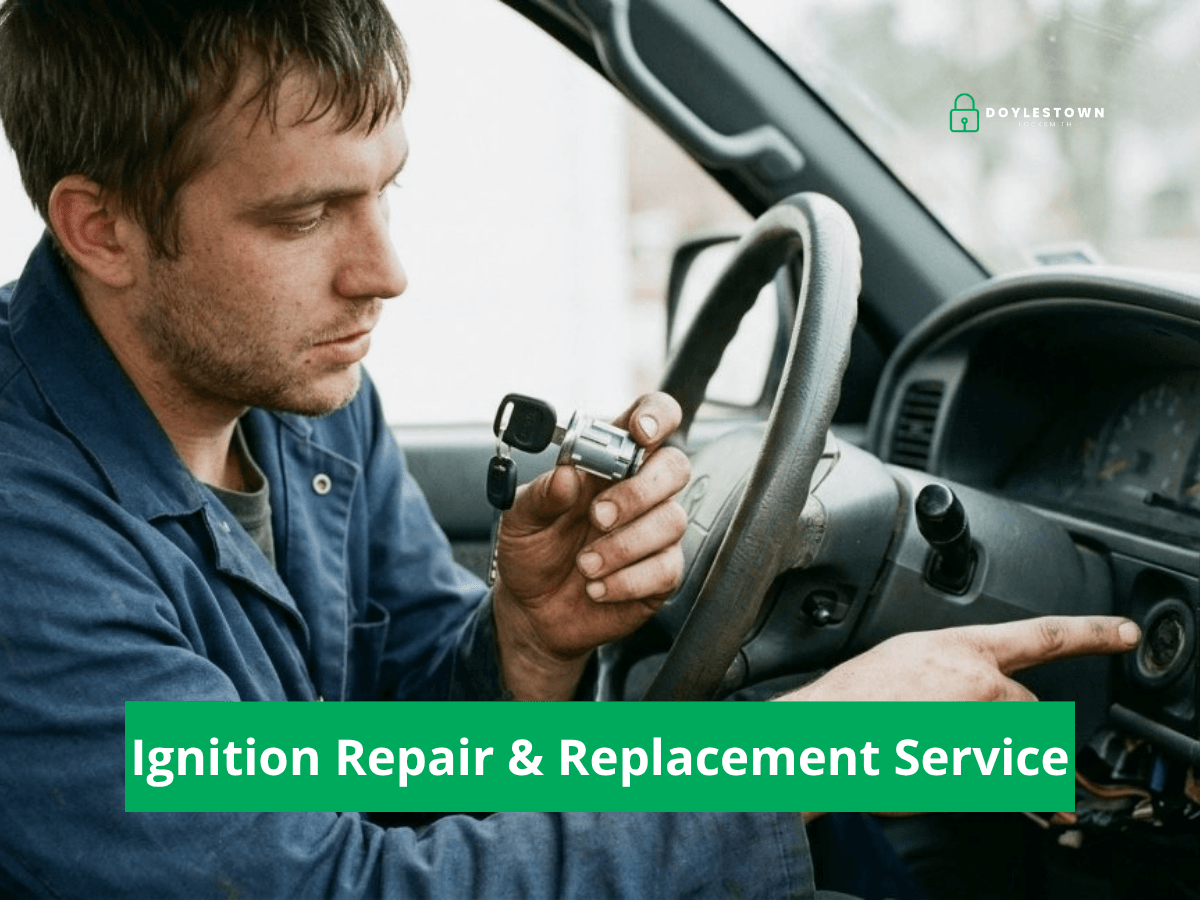
Common questions about ignition repair
Is it the key or the ignition?
This is the right question and the honest answer is: sometimes it is hard to tell without testing both. A worn key and a worn cylinder give nearly identical symptoms because they are two halves of the same mechanical relationship. A key that has been used daily for five or six years may have lost enough material that it no longer aligns reliably with the cylinder pins.
The way we determine it: we test with a spare key if you have one. If the spare works normally, the original key is the problem. If the spare has the same issue, the cylinder is the primary cause. If you do not have a spare, we assess the cylinder directly after removal. In some cases the answer is both, and we recommend addressing both at the same time.
How long does the repair take?
Most ignition jobs are completed in 45 to 90 minutes from the time we arrive. Simple cylinder repairs on the short end. Full replacements with transponder programming on the longer end. If your vehicle has a more complex ignition system or if parts need to be sourced, we will tell you upfront rather than give you an estimate that changes when we are already on-site.
Do you service all makes and models?
The large majority, yes. There are some exotic or very rare vehicles where specialized parts or proprietary programming systems require tools or sourcing that we do not carry in our mobile units. If that is the case, we will tell you on the call before dispatching. For the vast majority of vehicles on the road in Bucks County, we can handle ignition repair or replacement in a single visit.
Is towing required?
No. That is the core advantage of mobile ignition service. We come to wherever the car is: your driveway, a parking lot, the side of the road. The car does not need to move for us to work on it. If you are in a situation where the car is stuck in a location that creates a safety concern, call us and we will figure out the logistics together.
Will this affect my car's security system?
It can, which is why we address it proactively rather than after the fact. In modern vehicles with transponder keys, replacing the ignition cylinder without reprogramming the key means the car’s immobilizer will prevent the engine from starting even with the key fully inserted and turning correctly. We handle the programming as part of the replacement job, not as a separate step you have to take somewhere else.
If you need a key reprogrammed separately from ignition work, our key fob and transponder programming service handles that as a standalone service.
What if the ignition failed because of a break-in attempt?
A forced ignition from a theft attempt usually causes more damage than normal wear. The cylinder housing may be deformed, internal components may be sheared, and in some cases the steering column cover is also damaged. We assess all of this during diagnosis and give you a clear picture of what needs to be replaced before we start. If the car was stolen and recovered, there may also be car lockout or door lock issues to address at the same time.
Can I still use my existing key after ignition replacement?
In many cases, yes. Where possible we match the new cylinder to your existing key so you do not have to get a new one cut and programmed. Whether this is possible depends on the vehicle, the cylinder type, and the condition of your current key. We confirm this during diagnosis and give you the options before proceeding.
Your automotive locksmith near you
Ignition not working? Call 267-440-6484. We come to you anywhere in Bucks County: Doylestown, Warminster, Warrington, Chalfont, New Britain, Furlong, Jamison, Richboro, Montgomeryville and surrounding areas. No towing, no dealership wait.