
Professional master key systems for businesses One key, total control
Fast & Reliable Solutions Near You
Emergency service
Qualified Technicians
Guaranteed and Quality
Your office manager carries a keychain with 18 keys. Every morning, they fumble through them trying to remember which one opens the conference room, which one opens storage, which one opens the break room. It takes three tries before they find the right key. It’s frustrating, inefficient, and unprofessional.
Meanwhile, when an employee leaves, you face a decision: rekey every single lock they had access to (expensive), or hope they returned all their keys and didn’t make copies (risky).
There’s a better way.
A master key system gives you hierarchical access control: employees get keys that open only what they need, managers get keys that open more, and you maintain a master key that opens everything. No more massive keychains. No more security guesswork. Just organized, controlled access.
At Doylestown Locksmith, we design and install master key systems for businesses, office buildings, retail stores, medical facilities, and property management companies throughout Bucks County and surrounding areas.

The problem businesses face without master key systems
Let’s talk about what managing keys looks like without a proper system:
Key chaos: Your office has 15 doors. Your manager needs access to 10 of them. That’s 10 keys on their keychain. Multiply that across multiple managers and you’ve got dozens of keys floating around, constant confusion about which key opens what, and bulky keychains that make your team look disorganized.
Security risks: You have no idea how many copies of each key exist. Employees make copies for convenience. Former employees might still have keys. There’s no way to track who has access to what. If keys go missing, you don’t know which locks are compromised.
Expensive turnover: When an employee leaves, you should rekey every lock they had access to. If they had 5 keys, that’s 5 locks to rekey at $40-60 each. With typical employee turnover, you’re spending hundreds or thousands annually on rekeying.
No accountability: When something goes missing from storage or a door is left unlocked, you can’t determine who was responsible because multiple people have identical keys to the same areas.
Operational inefficiency: Need to give temporary access to a contractor? You hand them a key and hope they return it. Need to restrict access to sensitive areas? You install completely separate locks with different keys, adding more complexity.
A master key system solves all of these problems with one elegant solution.
How master key systems actually work
Here’s the technical explanation of how one lock can be opened by two completely different keys:
Standard lock operation
In a normal pin tumbler lock, you have 5-6 pin stacks. Each stack contains a key pin (bottom) and a driver pin (top) separated by a spring. When you insert the correct key, the cuts on your key lift each pin stack to a precise height, aligning all the driver pins exactly at the shear line. The cylinder can now rotate and the lock opens.
With a standard lock, only one key works because only one specific combination of pin heights creates that alignment.
Master keyed lock operation
In a master keyed lock, we add an additional component called a master wafer (or master pin) between the key pin and driver pin in each stack.
Now each pin stack has three pieces: key pin, master wafer, driver pin.
This creates two possible shear lines in each pin stack:
- First shear line: Between the key pin and master wafer (for the change key)
- Second shear line: Between the master wafer and driver pin (for the master key)
Your change key lifts the pins so the first shear line aligns throughout the cylinder. It works.
The master key lifts the pins to a different height so the second shear line aligns throughout the cylinder. It also works.
Same lock. Two different keys. Both function perfectly. That’s the engineering behind master key systems.
The hierarchy
In a typical business system:
Change keys open individual locks or small groups of locks. Each employee gets a change key that opens only what they need access to – maybe their office and the front door.
Master keys open entire sections or departments. A manager gets a master key that opens all the change key locks in their area, plus their own office.
Grand master keys open everything. The owner or facility manager has one key that opens every single lock in the building.
For larger facilities, you can add additional tiers: sub-master keys for departments, building master keys for individual buildings in a campus, and great grand master keys for entire multi-building complexes.
Real-world master key system examples
Let’s look at how this works in practice:
Small office building (12 doors)
Layout: Front entrance, 8 individual offices, conference room, storage room, break room
Without master key system:
- Owner: 12 keys
- Office manager: 10 keys (everything except 2 private offices)
- Each employee: 3-4 keys (their office + front door + break room + maybe conference room)
- Total keys in circulation: 40+ keys
With master key system:
- Owner: 1 grand master key (opens all 12 doors)
- Office manager: 1 master key (opens 10 doors, excluding 2 private offices)
- Each employee: 1 change key (their office + front door + common areas)
- Total keys: 10 change keys + 2 masters = 12 keys
When employee leaves: Rekey only their office ($40-60) instead of rekeying everything they had access to ($200-300).
Retail store (8 doors)
Layout: Front entrance, back door, sales floor gate, stock room, manager’s office, cash office, break room, bathroom
Key hierarchy:
- Owner (grand master): All 8 doors
- Store manager (master): All except cash office (7 doors)
- Assistant manager (sub-master): Front entrance, sales floor, stock room, break room, bathroom (5 doors)
- Sales staff (change keys): Front entrance, break room, bathroom (3 doors)
- Stock staff (change keys): Back door, stock room, break room, bathroom (4 doors)
Result: Perfect access control. Sales staff can’t access the stock room. Stock staff can’t access the sales floor after hours. Only the owner can access the cash office. Everyone has exactly what they need, nothing more.
Medical office (10 doors)
Security zones: Reception, 4 exam rooms, 2 staff offices, lab, medication room, storage
Key hierarchy:
- Physician (grand master): All areas
- Office manager (master): All except medication room
- Nurses (change keys): Reception, exam rooms, lab, storage
- Admin staff (change keys): Reception, staff offices
- Cleaning crew (change keys): Reception, staff offices, storage only
HIPAA compliance: You can track exactly who has access to patient areas and medication. No unauthorized access to controlled substances or medical records.
Apartment complex (30 units + common areas)
Access needs: 30 individual units, main entrance, laundry room, gym, package room, maintenance room, management office
Key hierarchy:
- Property manager (grand master): All 36 doors
- Maintenance staff (master): All units + common areas (for repairs/emergencies)
- Each tenant (change key): Their unit + common area amenities
- Cleaning service (change key): Common areas only, no units
When the tenant moves out: Rekey only their unit. All master keys and other tenant keys continue working. Simple, secure, cost-effective.
Levels of master key system complexity
Simple two-tier system (best for small businesses)
- Change keys for employees
- Master key for owner/manager
- Good for: 5-20 doors, single location, small team
- Cost: $800-1,800
Standard three-tier system (most common)
- Change keys for employees
- Master keys for managers/department heads
- Grand master for owner
- Good for: 15-50 doors, multiple departments or floors
- Cost: $1,500-3,500
Complex multi-tier system (large facilities)
- Change keys, sub-masters, masters, grand masters, great grand masters
- Good for: 50+ doors, multiple buildings, campus environments
- Cost: $3,500-10,000+
We’ll recommend the appropriate level based on your facility size, number of access points, and organizational structure.
Restricted keyways - Critical for security
Here’s something most businesses don’t understand: a master key system is only as secure as your key control.
If employees can walk into any hardware store and copy their keys, your entire system is compromised. That’s where restricted keyways come in.
Restricted keyways use patented key blanks that are only available to authorized locksmiths. You can’t buy these blanks at Home Depot or have them copied at a key kiosk. When we set up your system with restricted keyways:
- Only authorized personnel (you) can request duplicate keys
- We maintain records of every key issued
- Employees cannot make unauthorized copies
- You have true control over your security
We strongly recommend restricted keyways for any business master key system. The small additional cost provides invaluable security and control.
Our master key system process
Initial consultation and site survey: We visit your facility, document all doors and access points, discuss your organizational structure, understand who needs access to what, and identify security priorities. This consultation is free.
System design: We create a detailed key hierarchy plan showing change key groups, master key levels, and grand master structure. We specify which locks need new cylinders versus which can be rekeyed. You review and approve before we proceed.
Quote and timeline: We provide a comprehensive quote covering design, hardware (if needed), installation, and all keys. We establish a timeline that minimizes disruption to your operations.
Implementation: We rekey existing compatible locks or install new master-keyed cylinders as needed. For large projects, we often work in phases or off-hours to avoid business disruption.
Key cutting and documentation: We cut all change keys, master keys, and grand masters according to the approved hierarchy. We provide complete documentation showing which keys open which locks, and maintain backup records for future reference.
Training and handoff: We train your management team on the system, explain key control procedures, and provide documentation. You receive all keys organized and labeled.
Ongoing support: As your business grows or changes, we add new locks to the system, rekey when needed, replace lost keys, and maintain security.
For businesses needing comprehensive commercial locksmith services beyond master key systems, visit our commercial locksmith page.
Key control best practices
Having a master key system isn’t enough – you need proper key control procedures:
Maintain a key registry: Document who has which keys, when they were issued, and get signatures upon receipt.
Use restricted keyways: This prevents unauthorized copying and gives you real control.
Establish a key replacement policy: When keys are lost, charge a replacement fee and rekey if necessary. Don’t just make another copy.
Conduct annual audits: Verify who has keys and ensure separated employees return theirs.
Secure master keys: Store master and grand master keys securely. Don’t leave them lying around or lend them casually.
Rekey promptly after separations: When managers or employees with master keys leave, rekey at the appropriate level immediately.
Never duplicate the grand master: Keep one or two grand masters maximum, stored securely. Every additional copy is a security risk.
If you need to rekey portions of your system due to lost keys or personnel changes, our lock rekeying service can handle updates without rebuilding the entire system.
When to rekey vs. rebuild your system
Rekey individual locks when:
- An employee with a change key leaves
- A single change key is lost
- Routine turnover in your organization
Rekey a master key group when:
- A manager with a master key leaves
- A master key is lost or stolen
- Reorganizing a department’s access
Rebuild the entire system when:
- The grand master key is lost or compromised
- You’ve had the system 10+ years without updates
- Major facility expansion or reorganization
- You suspect widespread unauthorized key copying
- You didn’t use restricted keyways initially
We’ll honestly assess whether you need partial rekeying or a complete system rebuild.
Investment and return
Master key systems aren’t just about convenience – they’re a smart financial investment:
Without master key system:
- 3 employees leave per year
- Each had 5 keys
- Rekey 15 locks/year at $50 each = $750/year
- Plus operational inefficiency and security risk
With master key system:
- 3 employees leave per year
- Rekey 3 locks (one per employee) = $150/year
- Better security and significantly improved operations
Payback period: If a $2,000 master key system saves you $600/year in rekeying plus immeasurable operational efficiency, it pays for itself in 3-4 years and continues saving money indefinitely.
Factor in the value of improved security, better access control, and professional operations, and the ROI is even clearer.
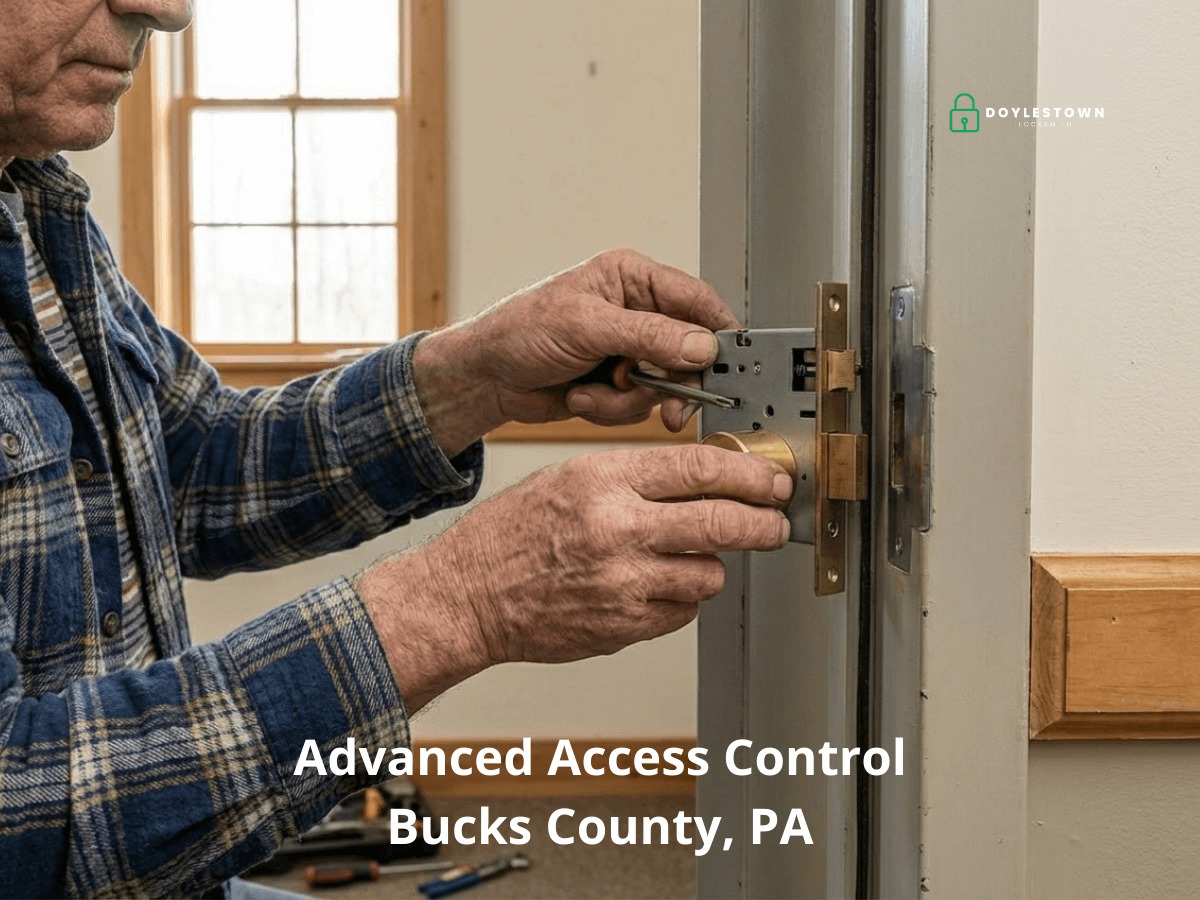
Where we design and install master key systems
Our mobile service brings master key system design, installation, and maintenance directly to your facility.
We serve all of Bucks County, PA and surrounding areas including:
- Doylestown
- Warminster
- Warrington
- Chalfont
- New Britain
- Furlong
- Jamison
- Richboro
- Montgomeryville
- Telford
- Quakertown
- Hatboro
- Willow Grove
- Horsham
- Southampton
- Newtown
- Yardley
- Langhorne
Master key system questions answered
How much does a master key system cost?
It depends on the number of locks, system complexity, and whether we’re rekeying existing locks or installing new hardware:
- Small system (10-20 doors): $800-2,000
- Medium system (20-50 doors): $2,000-4,500
- Large system (50+ doors): $4,500-10,000+
Consider the ROI: if you spend $800-1,200 annually on rekeying due to turnover, a $2,000 system pays for itself in 2-3 years while providing better security and convenience.
Can my existing locks be master keyed?
Most standard pin tumbler locks can be reconfigured for master keying. We’ll inspect your current hardware and let you know what’s compatible. Worn or low-quality locks may need replacement, which we’ll include in the quote.
What happens if I lose a master key?
This is serious. If a change key is lost, we rekey that one lock. If a master key is lost, we must rekey every lock in that master key group. If a grand master is lost, we must rekey the entire system. This is why we emphasize restricted keyways and proper key security.
Can employees copy their keys?
Not with restricted keyways. The key blanks are patented and controlled. Only authorized locksmiths with your written permission can duplicate keys. Without restricted keyways, yes, employees can copy keys at any hardware store, which undermines your security.
How do you handle employee turnover?
When an employee leaves, they return their change key. We rekey only their specific lock(s) – typically $40-75 per lock. All master keys and other employee keys continue working. It’s far more cost-effective than rekeying everything.
What if my business expands?
We seamlessly integrate new locks into your existing hierarchy. Need to add 5 new offices? We configure them into your current system, cut the appropriate change keys, and your master keys automatically work on the new locks. The system grows with you.
Does a master key system reduce security?
Not if properly designed and managed. It actually increases security through better access control and accountability. The risk comes from poor key control – unauthorized copies, lost master keys, or non-restricted keyways. That’s why we emphasize restricted keyways and documentation.
How long does installation take?
A small office (10-15 doors) might take 4-6 hours. A larger facility could take 1-3 days, depending on complexity. We can work after hours or in phases to minimize disruption to your business operations.
Can I add electronic locks to a master key system?
Yes. Many modern electronic locks can be integrated with mechanical master key systems, giving you the benefits of both. You might use electronic locks on main entrances while maintaining mechanical master keyed locks throughout the building.
What's the difference between master keying and keyed alike?
Keyed alike means all locks use the same key – everyone has identical access. Good for homeowners who want one key for all doors.
Master key system means hierarchical access – different people have different levels of access using different keys. Essential for businesses where not everyone should access everything.
For residential needs or simple keyed alike systems, see our residential locksmith services.
Do you provide key cutting for existing master key systems?
Yes. If you have an existing master key system and need additional change keys cut, we can help. We’ll need to see your key and documentation to ensure we maintain your system’s security structure.
Our key duplication service handles both standard keys and master key system components.
Ready to implement a master key system?
Stop managing dozens of keys and start managing access intelligently. A professional master key system gives you control, security, and operational efficiency.
When you call, please tell us:
- Type of business or facility
- Approximate number of doors/locks
- Current key management challenges
- Timeline for implementation
We’ll schedule a free on-site consultation to assess your needs and provide a detailed proposal.