
Commercial panic bar installation in Bucks County, PA
Emergency service
Qualified Technicians
Guaranteed and Quality
Your inspector flagged it. Your insurance company is asking questions. Or you are opening a new location and want to do it right from day one.
Whatever brought you here, the situation is the same: you need a panic bar installed correctly, by someone who knows the codes, works fast, and does not leave you with a door that fails the next inspection.
Doylestown Locksmith installs and repairs panic bars across Bucks County for restaurants, offices, retail stores, warehouses, medical clinics, and any commercial space with an emergency exit requirement. We work with the leading brands on the market and handle everything from single-door installs to multi-exit commercial projects.
Call 267-440-6484 or request a free quote and we will get back to you the same day.
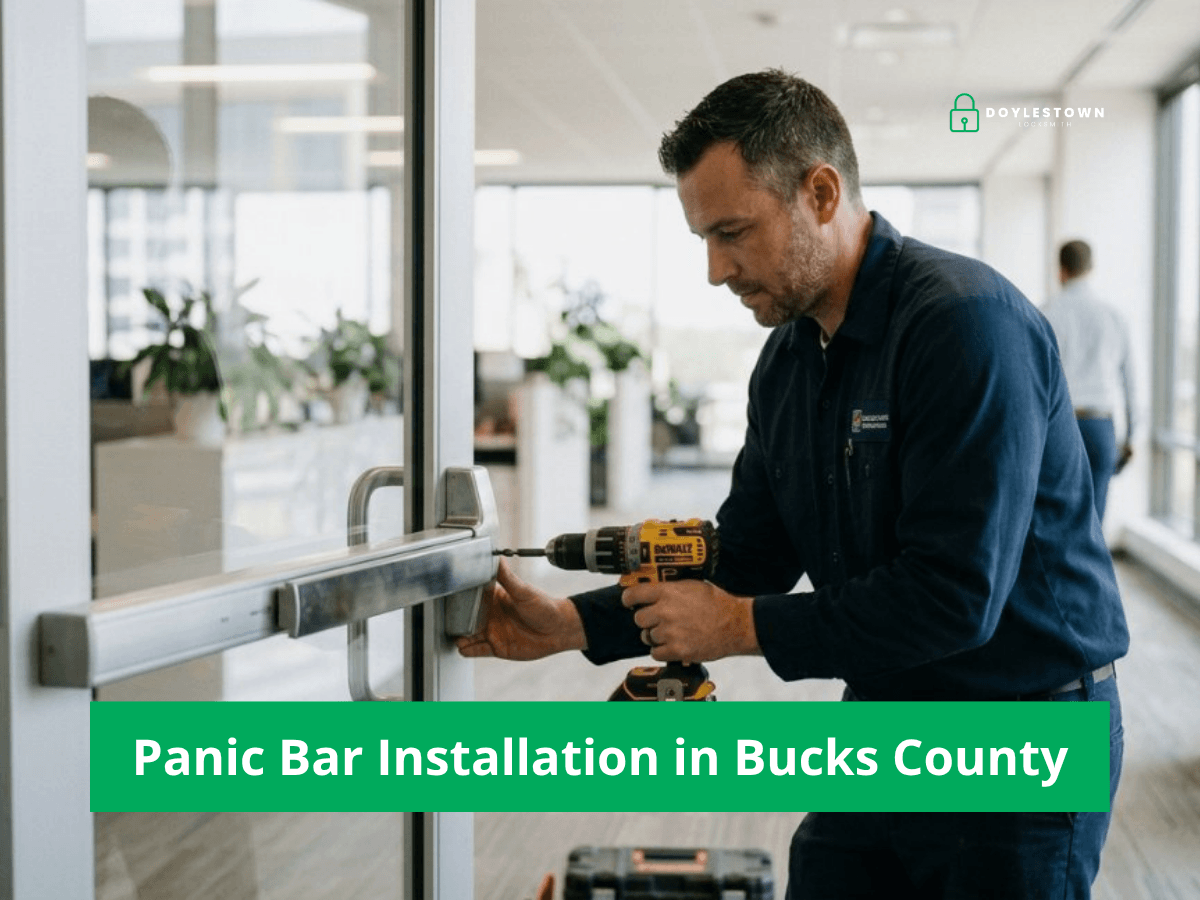
Why your business may need a panic bar
Panic bars exist for one reason: in an emergency, a person in a panic needs to be able to exit a building in a single motion without thinking about how the door works. No turning a knob, no pushing a lever, no fumbling with a handle. One push and the door opens.
That is the requirement behind the code, and the code is not optional.
Fire code and life safety compliance
Under the International Building Code and NFPA 101, most commercial occupancies with an occupant load of 50 or more people are required to have panic hardware on exit doors. If your space serves the public, employs a significant number of people, or is classified as an assembly, educational, or high-hazard occupancy, the requirement almost certainly applies to you.
Failing an inspection is not just a paperwork problem. It can result in fines, a required closure, or loss of your certificate of occupancy. If your building was flagged and you have a deadline to correct it, that is exactly the situation we are set up to handle quickly.
After a break-in or hardware failure
Panic bars take abuse. A device that was forced during a break-in attempt, or that has been pushed hard by employees for years, may look functional but fail under load. If your panic bar is stiff, does not latch cleanly, or the push pad has any play in it, it needs to be looked at. A faulty panic bar is a liability, not just a nuisance. Our commercial locksmith team handles both new installations and repairs on existing devices.
New construction or tenant buildout
If you are fitting out a new commercial space, panic bars should be planned into the door hardware spec from the beginning. Retrofitting after the fact costs more and sometimes requires modifications to the door frame. We work with contractors, property managers, and business owners during buildout to make sure exit hardware is correct before the certificate of occupancy inspection.
Types of panic bars we install
The right device depends on your door type, frame construction, and local code requirements. Here is how the main options break down in practical terms:
Rim exit devices (the most common installation)
Rim devices mount on the surface of the door and connect to a rim latch at the top or side of the door frame. They are the standard choice for most commercial doors and the easiest to install on existing hollow metal or wood doors. Brands like Von Duprin and Falcon make rim devices that are widely specified by architects and accepted by code officials across Pennsylvania.
Mortise exit devices
Mortise devices are built into the door body itself, integrating with a mortise lock chassis. They are more common on higher-end commercial doors and offer a more finished appearance. If your door already has a mortise lock and you need to add a panic function, a mortise exit device is usually the right direction.
Surface-mounted vertical rod devices
On double doors or pairs of doors without a center post, vertical rod devices engage both the top and bottom of the door frame. They are the correct solution for wide openings that need to remain unobstructed. These are standard in restaurant back-of-house exits, loading dock doors, and double-door retail entries.
Panic bars with door alarms
Some businesses need panic bars on exits they do not want used as everyday shortcut doors. A Detex alarm bar or an exit device with a built-in alarm will sound when the door is opened outside of designated hours or without a code override. This is common in retail environments where shrinkage through back exits is a concern, and in office buildings where certain stairwell exits should remain emergency-only.
If your goal is full control over who exits and when, we can pair a panic bar with our access control installation service for a complete solution.
How we handle the installation
- Door evaluation. We assess the door type, thickness, frame material, and existing hardware. We confirm what device is compatible and identify any frame modifications needed before we start.
- Code compliance check. We verify the applicable requirements for your occupancy type and local jurisdiction. If there are ADA considerations or specific fire door requirements, we address those before selecting the hardware.
- Installation. We install the exit device, align the latch or rod mechanism with the door frame, and secure all mounting hardware. For alarm-equipped devices, we test the alarm circuit and configure any override codes.
- Function and force testing. We test the push pad force, confirm the door opens cleanly with one motion, and verify the latch re-engages when the door closes. The device should function without adjustment for years.
- Documentation. We provide a record of the hardware installed, including brand and model, which you may need for your inspection or insurance documentation.
Most single-door panic bar installations are completed in one visit. Multi-exit or complex commercial projects are scoped in advance so you know the timeline before we start.
Businesses we work with in Bucks County
Every business type has slightly different exit requirements and daily use patterns. Here is how that plays out in practice:
Restaurants and food service
Your kitchen exit sees heavy traffic from staff who are often carrying things. It needs to open with a bump from a hip or an elbow. Panic hardware is almost always required on back-of-house exits in food service, and it takes more abuse than almost any other commercial application. We install heavy-duty devices rated for high-cycle use.
Retail stores
Back-room and loading dock exits are the most common install points. Alarm-equipped devices are popular in retail because they deter employees from propping the door or using it as a casual exit without it being logged. We can also integrate with existing alarm systems if needed.
Offices and professional spaces
In multi-tenant office buildings, stairwell doors are the primary location. If you manage the building rather than a single tenant, we can handle multiple doors in a single visit and set up a master key system that gives authorized personnel override access without defeating the emergency function.
Warehouses and industrial spaces
Wide openings, double doors, and loading dock exits are standard in warehouse environments. Vertical rod devices are common here, as are heavy-duty rim devices rated for the temperature swings and rough handling typical of industrial use. We stock devices suitable for metal fire doors in these environments.
Medical clinics and healthcare facilities
Controlled access is a real concern in healthcare, but emergency exits still have to comply with life safety codes. We install panic hardware that satisfies both requirements, including devices that can be integrated with your existing access control system so the door is controlled during normal operations but always opens freely in an emergency.
Why working with a local locksmith makes a difference here
Panic bar installation is not complicated hardware to source online. The difference is in knowing which device is actually required for your door and occupancy type, and installing it in a way that passes inspection the first time.
National chains send whoever is available. When you call Doylestown Locksmith, you get a licensed professional who knows Bucks County, knows what local inspectors look for, and will tell you upfront if there is an issue with your door or frame that affects the install.
We are based in Doylestown and serve Warminster, Warrington, Chalfont, New Britain, Furlong, Jamison, Richboro, Montgomeryville, and the surrounding area. No dispatch center, no contractor subcontracting to another contractor. You call us, we show up.
We also repair existing panic bars
Not every situation calls for a new device. If your current panic bar is stiff, misaligned, making noise, or fails an inspection due to a worn component, repair is often faster and less expensive than replacement.
Common repair situations we handle:
- Push pad does not spring back after release
- Latch does not re-engage when the door closes
- Rod mechanism on a vertical rod device has bent or disconnected
- Alarm on an exit device sounds at the wrong time or not at all
- Device was forced during a break-in and no longer functions correctly
If we arrive and determine that repair is not a reliable long-term fix, we will tell you that before doing any work. For other commercial door hardware issues beyond panic bars, see our full commercial lock repair and installation services.
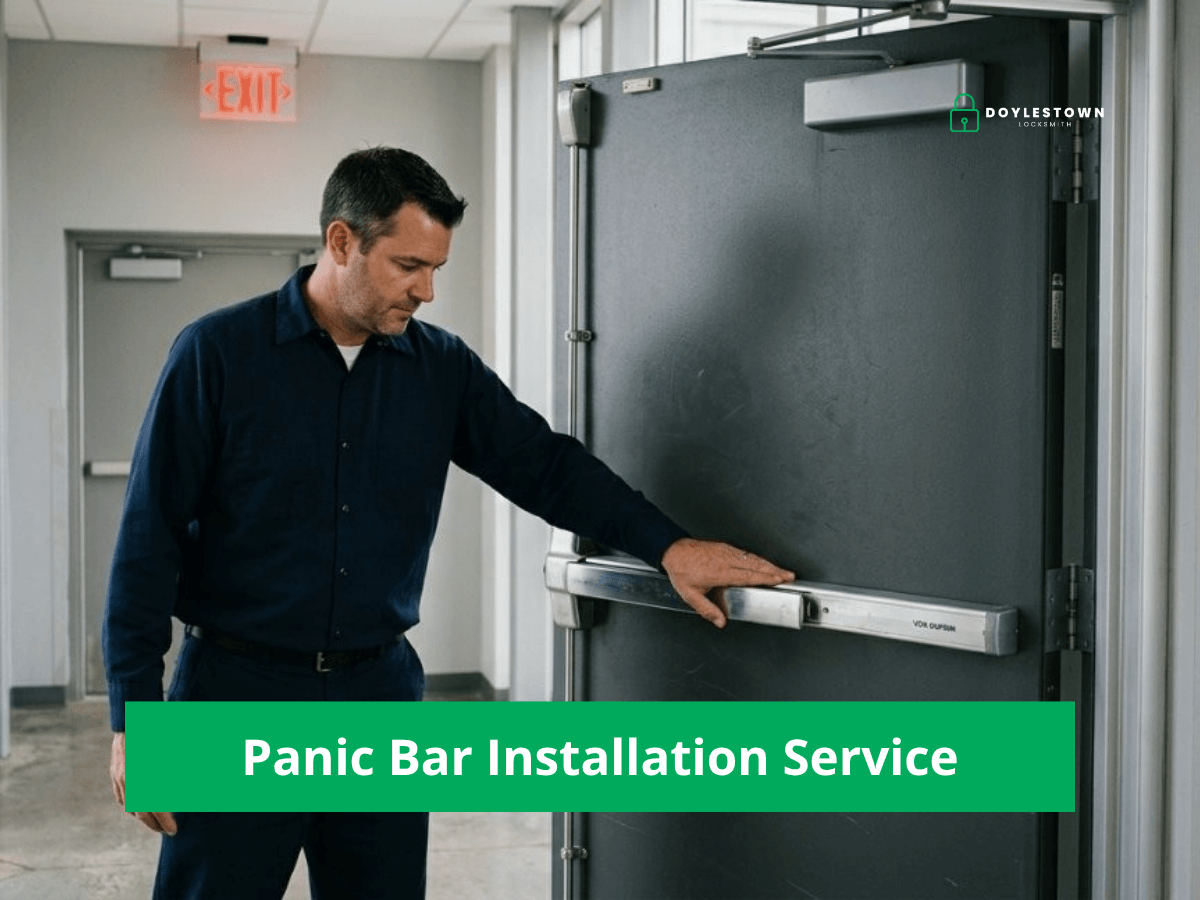
Common questions about panic bar installation
Are panic bars required by law?
It depends on your occupancy classification and the specific use of the door. Under the International Building Code, panic hardware is required on doors serving assembly occupancies with an occupant load over 50, educational facilities, high-hazard occupancies, and certain other classifications. If you are unsure whether your space qualifies, the fastest answer is to call your local building or fire marshal’s office, or call us and we can walk through the basics with you.
How long does installation take?
A standard single-door installation takes one to two hours. If the door frame needs modification, or if you have multiple exits to address, we scope the project in advance so you know what to expect before we start. We do not give vague estimates and then surprise you onsite.
Can you retrofit a panic bar onto an existing door?
In most cases, yes. Rim exit devices are designed specifically for retrofit installation on existing doors. Mortise devices require more door prep but are still frequently retrofitted. The main variable is the door’s condition and whether the frame can accept the strike hardware. We assess this during the evaluation before quoting the job.
Do you repair panic bars, or only install new ones?
Both. If your existing device has a fixable problem, we prefer to repair it. If it is worn past reliable function, we will recommend replacement and show you the options. We carry parts for common Von Duprin, Falcon, and Detex devices.
What about the door alarm option? Will it go off every time someone uses the exit?
Alarm-equipped devices can be configured with a delay, a key override, or a code that lets authorized users open the door without triggering the alarm. Staff who are supposed to use the exit can do so normally. The alarm activates for anyone who does not have the override, or during hours when the door should not be in use. We configure all of this during installation.
Do you work with property managers on multi-tenant buildings?
Yes. If you manage a building with multiple exits across multiple tenant spaces, we can coordinate a single visit to address all the doors. We also set up master key access for building staff so emergency exits can be managed without giving every tenant the same key. See our master key system service for details on how that works.
Failed inspection? Opening a new location? Panic bar not working?
Call 267-440-6484 or get a free quote online. We serve Doylestown, Warminster, Warrington, Chalfont, New Britain, Furlong, Jamison, Richboro, Montgomeryville and all of Bucks County.