
Deadbolt installation for homes in Bucks County, PA
Fast & Reliable Solutions Near You
Emergency service
Qualified Technicians
Guaranteed and Quality
Most homes with a knob lock and no deadbolt have a door that can be forced open in a matter of seconds. Not picked, not bypassed with a credit card. Kicked. The knob lock bends, the strike plate pulls away from the frame, and the door opens.
A properly installed deadbolt changes that entirely. The bolt extends deep into the door frame, the strike plate anchors to the structural framing behind the jamb, and the door becomes significantly harder to force regardless of how much pressure is applied.
Doylestown Locksmith installs deadbolts on residential doors throughout Bucks County. We carry Grade 1 hardware from trusted brands, handle the full installation including strike plate reinforcement, and make sure the lock functions correctly before we leave. Most jobs are completed in a single visit.
Call 267-440-6484 or request a free quote to schedule an installation.
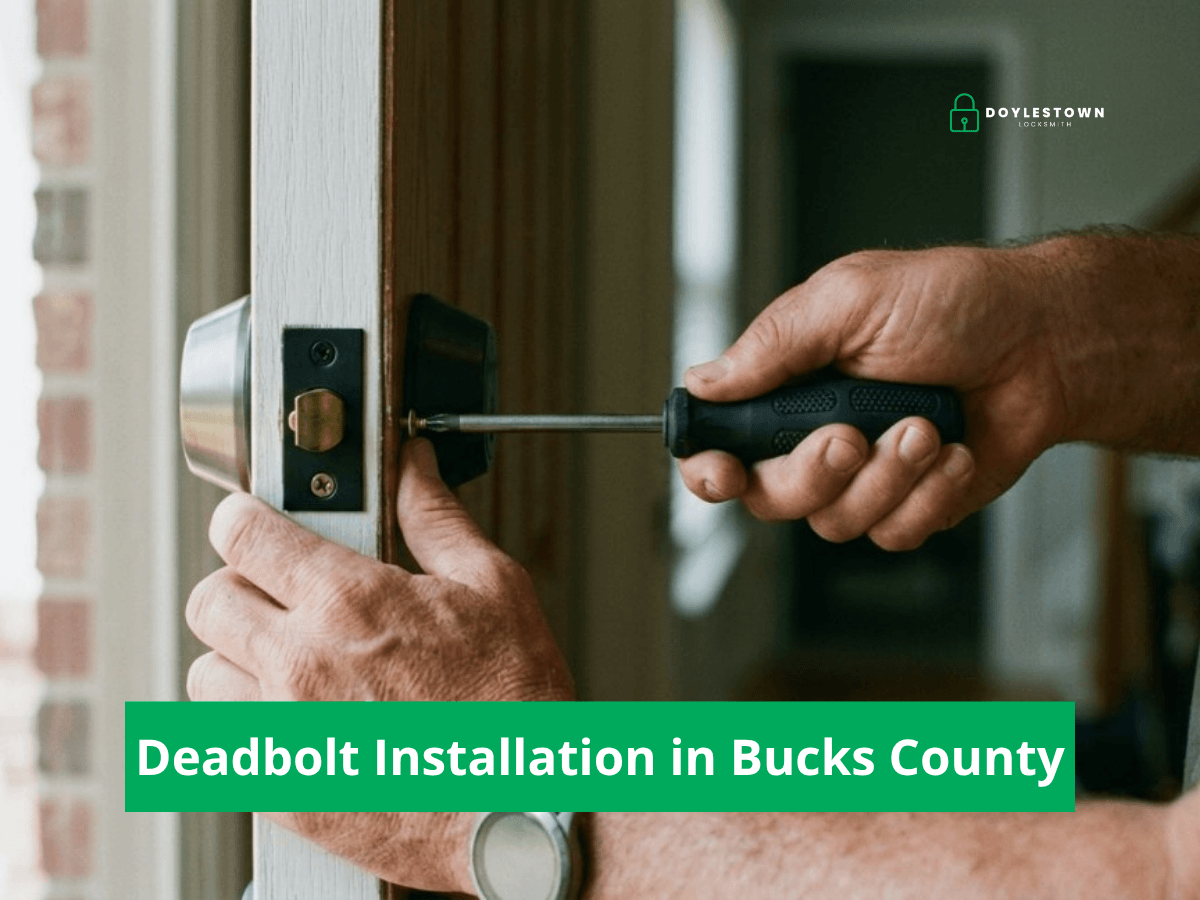
Why a deadbolt makes a real difference
The difference between a knob lock and a deadbolt is not just hardware. It is how each one responds to force.
A knob lock has a spring latch that can flex under pressure. The mechanism is inside the knob itself, which gives an intruder something to grab and apply torque to. Even a locked knob is not particularly resistant to a solid kick at the right angle.
A deadbolt works differently. When locked, a solid steel bolt extends into the door frame. There is no spring, no flex, and nothing to grip from the outside. The lock can only be opened by retracting the bolt with a key or a thumb turn, and the weakest point in the system is no longer the lock itself but the strike plate and the frame around it.
That is where most break-ins actually happen: not through the lock, but through the frame. A kick-in does not defeat the deadbolt. It defeats the strike plate if it is held by short screws in soft wood. Which is why installation matters as much as the hardware itself.
What insurance companies and code requirements say
Many homeowner insurance policies specifically require deadbolts on all exterior doors as a condition of coverage, or offer premium discounts for homes that have them. If you are in a rental property, some lease agreements require deadbolts under Pennsylvania landlord-tenant law. If you are unsure what applies to your situation, having a deadbolt on every exterior entry point is the right baseline regardless of what any policy requires.
Types of deadbolts we install
The right choice depends on your door, your lifestyle, and how you want to manage access. Here is how each type works in practice:
Single cylinder deadbolt
The standard deadbolt for most residential exterior doors. A key operates the lock from the outside. A thumb turn operates it from the inside. Simple, reliable, and available in Grade 1 through Grade 3 ratings. For most homeowners, a single cylinder deadbolt in ANSI Grade 1 is the right balance of security and convenience.
Grade 1 is the highest residential rating and means the lock has been tested to withstand significant force, repeated operation cycles, and pick resistance. A Grade 1 deadbolt from Schlage or Kwikset with a properly reinforced strike plate is meaningfully more secure than what ships with most new construction homes.
Double cylinder deadbolt
Requires a key to operate from both sides. Used when the door has glass panels near the lock, because a standard deadbolt with a thumb turn can be opened by breaking the glass and reaching inside. The double cylinder removes that vulnerability.
There is an important tradeoff that any honest locksmith should tell you: a double cylinder deadbolt means that in an emergency, anyone inside the house who does not have the key cannot get out through that door. Some fire codes restrict or prohibit them in certain applications. If you are considering one because of glass panels near your door, we will walk through the options with you before recommending it.
Keypad deadbolt
Operates with a PIN code instead of a physical key. The deadbolt mechanism is the same as a single cylinder, but entry is code-based. Keypad deadbolts are a practical solution for households with multiple people who need access, rental properties between tenants, or anyone who wants to stop managing physical keys. You change the code rather than rekeying the lock.
If you are a landlord or Airbnb host, a keypad deadbolt is often the most cost-effective access management solution available. No rekeying between guests, no keys to collect, and code changes take thirty seconds.
Smart deadbolt
Connects to your home’s WiFi or a hub and can be managed via smartphone app. You can lock and unlock remotely, grant access to specific people for specific time windows, and see a log of every entry. Smart deadbolts from brands like Schlage Encode and Yale Assure are available in Grade 1 and integrate with most major smart home platforms.
For a full breakdown of smart lock options and how they compare, see our smart lock installation page. If you are deciding between a keypad deadbolt and a full smart lock, that page covers the distinction in detail.
A note on hardware quality: not all deadbolts at the home improvement store are the same. The price difference between a Grade 3 deadbolt and a Grade 1 deadbolt from the same brand is often $20 to $40. The security difference is substantial. We recommend Grade 1 for all exterior doors and can supply hardware directly or work with what you have purchased.
When homeowners call us for deadbolt installation
Most deadbolt installations are not planned far in advance. Something changes, and the lock situation that was fine last month is suddenly not good enough.
Moving into a new home
You do not know who has keys to your new home. The previous owner, their family members, their contractors, the real estate agent. Rekeying changes the lock to work with a new key and is the minimum step after moving in. But if the existing deadbolt is worn, old, or a builder-grade lock that was never particularly secure, this is the right moment to replace it with something better. A fresh lock with new hardware, properly installed, means you start with a clean baseline.
After a break-in or an attempt
If your door was kicked in or someone tried to force it, the frame and strike plate almost certainly need attention even if the door looks fine from the outside. A door that was forced once is easier to force again because the frame has been weakened. We assess the full entry point, not just the lock, and make sure the repair addresses the actual vulnerability rather than just replacing the visible hardware.
Worn or old hardware that is not functioning reliably
A deadbolt that sticks, that requires the door to be lifted slightly to engage the bolt, or that has visible wear on the cylinder is overdue for replacement. Worn locks are easier to pick, easier to bypass, and more likely to fail at an inconvenient moment. If your current deadbolt is more than ten years old and was builder-grade to begin with, it has probably been providing less protection than you think.
If the deadbolt itself is in good condition but you are concerned about who has copies of the key, rekeying may be the more cost-effective answer. Our lock rekeying service handles that without replacing the hardware.
Rental properties and Airbnb
Every tenant rotation is a question about who has keys and whether they were copied. A keypad or smart deadbolt eliminates that question entirely. Code changes between tenants take less than a minute, there are no keys to collect, and you can grant access remotely without being on-site. For property managers handling multiple units, this compounds quickly into significant time savings.
Keys returned but you are not entirely certain
A roommate moved out. A family member returned their copy. A contractor finished the job. The keys came back, but you did not watch them make any copies and you have no way of knowing for certain. This is a completely normal situation and a legitimate reason to either rekey or replace the lock. If the existing deadbolt is in good shape, rekeying costs less. If it was due for an upgrade anyway, this is the moment to make it.
How we install a deadbolt
Door measurement and backset check: We confirm the backset distance from the edge of the door to the center of the lock bore, typically 2-3/8 inches or 2-3/4 inches depending on your door. If there is no existing bore or the new deadbolt requires a different bore size, we measure and drill to the correct specification.
Bore preparation and alignment: If drilling is required, we ensure the bore is clean, centered, and at the correct height relative to the existing knob or handle below. Alignment matters because a deadbolt installed even slightly off-center will not bolt smoothly into the strike and will wear unevenly over time.
Strike plate reinforcement: This is the step that makes the largest real-world difference in security. The standard strike plate that comes in the box is typically held by short screws that only reach the door jamb, not the structural framing behind it. We install a heavy-duty strike plate secured with three-inch screws that anchor into the wall framing. A kick-in against a door with this setup requires dramatically more force than one with standard installation.
Deadbolt installation and adjustment: We install the deadbolt, verify the bolt extends and retracts cleanly, and adjust the strike plate alignment so the bolt seats completely with a smooth quarter turn. A deadbolt that requires any lifting or pushing of the door to lock is not properly installed.
Full security check: We test the lock from both sides, verify the bolt fully extends in the locked position, and check that the door closes and latches cleanly without any movement in the frame. We also look at the door frame condition and hinges, because a well-installed deadbolt on a deteriorating frame is not actually more secure.
Most single-door deadbolt installations are completed in 45 to 60 minutes. Installations that require boring new holes or significant frame work may take longer. We assess during the visit and confirm the timeline before starting.
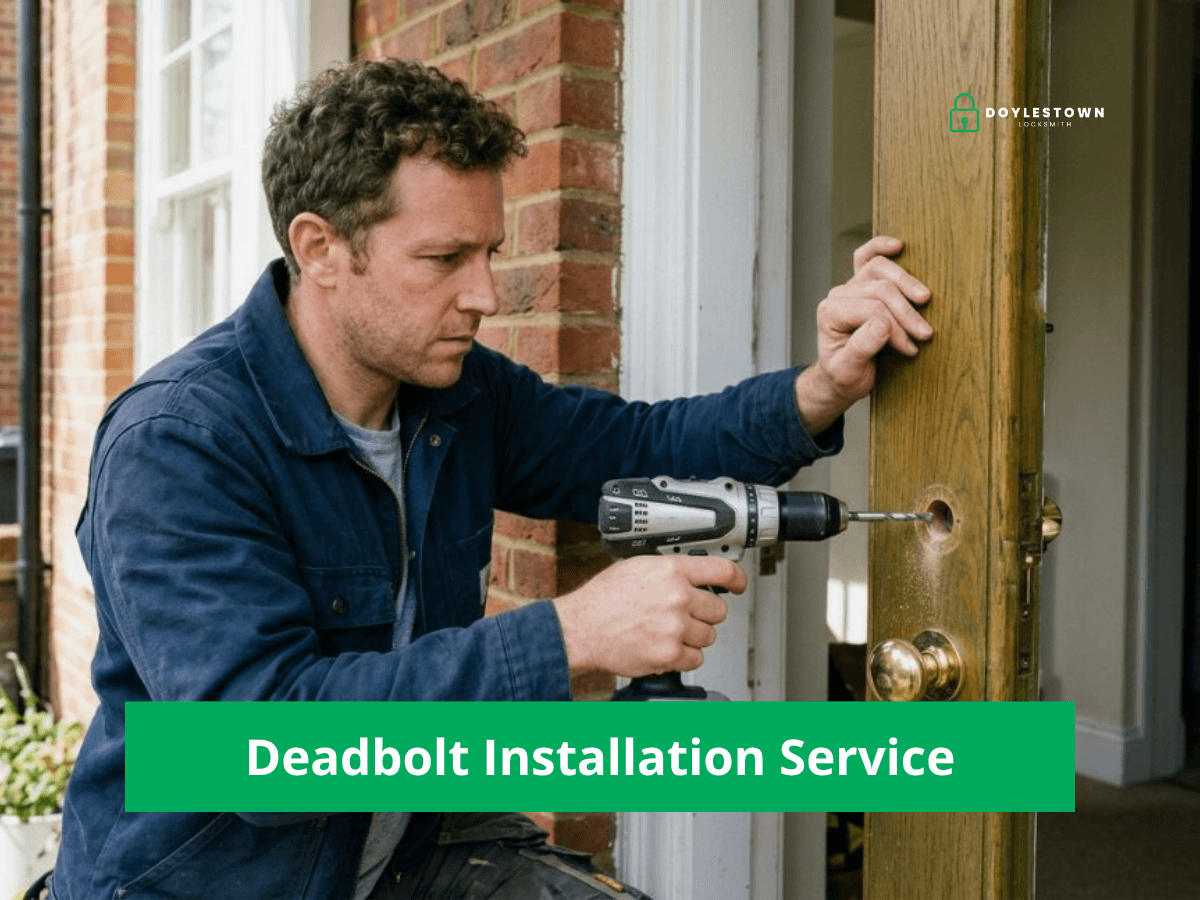
Questions about deadbolt installation
Can I install a deadbolt myself?
Technically yes, and many people do. The complications that come up are not always obvious until they occur: a door frame that is not perfectly square, a backset that does not match the hardware, a bore that ends up slightly off-center, or a strike plate installed with the short screws that came in the box. None of these prevent the lock from working day-to-day, but they affect both security and longevity. The reinforced strike plate installation in particular requires knowing what you are anchoring into, because a strike plate bolted into soft jamb wood provides almost no resistance to a kick regardless of how good the deadbolt itself is.
How much does deadbolt installation cost?
It depends on the hardware you choose and whether boring is required. We give you an upfront quote before starting any work. If you have already purchased the hardware, we can install it. If you want us to supply it, we carry Grade 1 deadbolts and can walk you through the options. There are no diagnostic fees or hidden line items.
Can you install a deadbolt on a metal door?
Yes. Metal doors and metal frames are common in Bucks County, particularly on older homes and rental properties. The installation approach is slightly different from wood doors, and the strike plate reinforcement method varies depending on the frame material. We carry the appropriate hardware for both wood and metal door applications.
Is a deadbolt better than a knob lock?
For security, yes, by a significant margin. A knob lock alone on an exterior door is not adequate protection. The mechanism is weaker, the knob itself is a leverage point, and the standard installation is more vulnerable to force. A deadbolt should be on every exterior door in addition to, not instead of, any knob or handle set. The two serve different purposes: the knob provides a convenient latch for everyday use, the deadbolt provides the actual security.
Do I need a deadbolt on every door?
Every exterior entry point should have one. That includes the front door, back door, side door, and the door from your garage into the house. The garage entry door is the one most often overlooked, and it is also frequently the least secure door in the home because people assume the garage door itself is sufficient protection. It is not. See our garage door lock services if that door specifically needs attention.
How long does installation take?
A standard installation on an existing bore takes 45 to 60 minutes. If new drilling is required or the frame needs reinforcement work beyond the standard strike plate, plan for 60 to 90 minutes. We do not give you a rushed installation to hit a time window.
What if I already have a good deadbolt but I am worried about who has keys?
Rekeying is the right answer in that case. We repin the existing cylinder so your current keys no longer work and cut you a new set. It is less expensive than full replacement and makes sense when the deadbolt itself is in good condition. Our lock rekeying service covers the process and pricing in detail.
What brands do you install?
We work with Schlage, Kwikset, Yale, and other reputable hardware brands. For Grade 1 residential deadbolts, Schlage B60N and Kwikset 980 are reliable, widely available, and priced fairly for what they offer. We can also install hardware you have already purchased. If you are unsure what to buy, call us before you purchase and we can point you in the right direction.
Ready to upgrade your locks? Call 267-440-6484 or request a free quote online. We serve Doylestown, Warminster, Warrington, Chalfont, New Britain, Furlong, Jamison, Richboro, Montgomeryville and all of Bucks County. Same-day installation available.
Ready to implement a Deadbolt Installation?
Ready to upgrade your locks? Call 267-440-6484 or request a free quote online. We serve Doylestown, Warminster, Warrington, Chalfont, New Britain, Furlong, Jamison, Richboro, Montgomeryville and all of Bucks County. Same-day installation available.